From field notebook to publishable data
Padiush carries a whole ethnobotanical study: interviews and field records captured even with no signal, local names reconciled against accepted taxa, and quantitative indices with their formulas cited.
Free software, in Spanish, English and Portuguese.
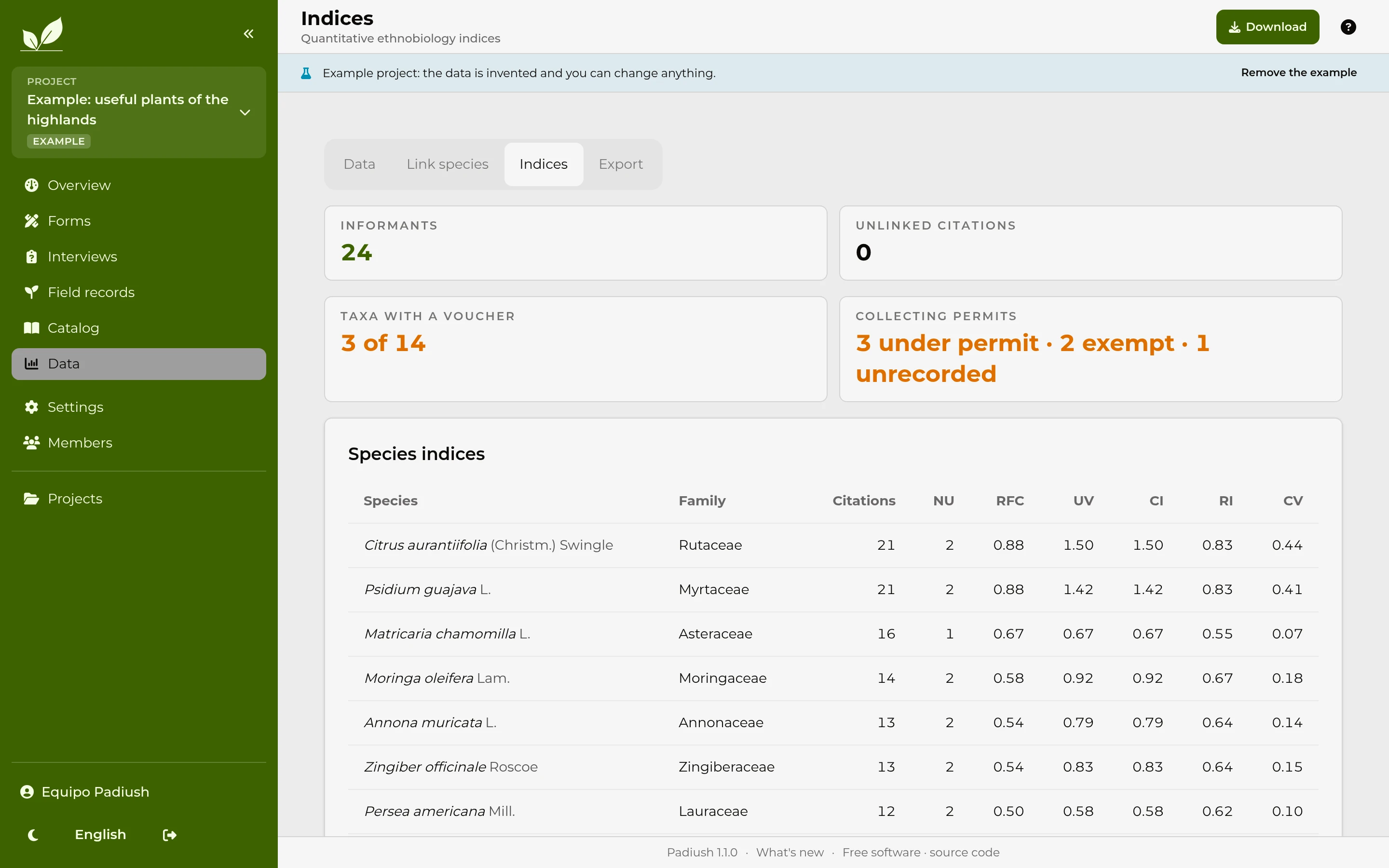
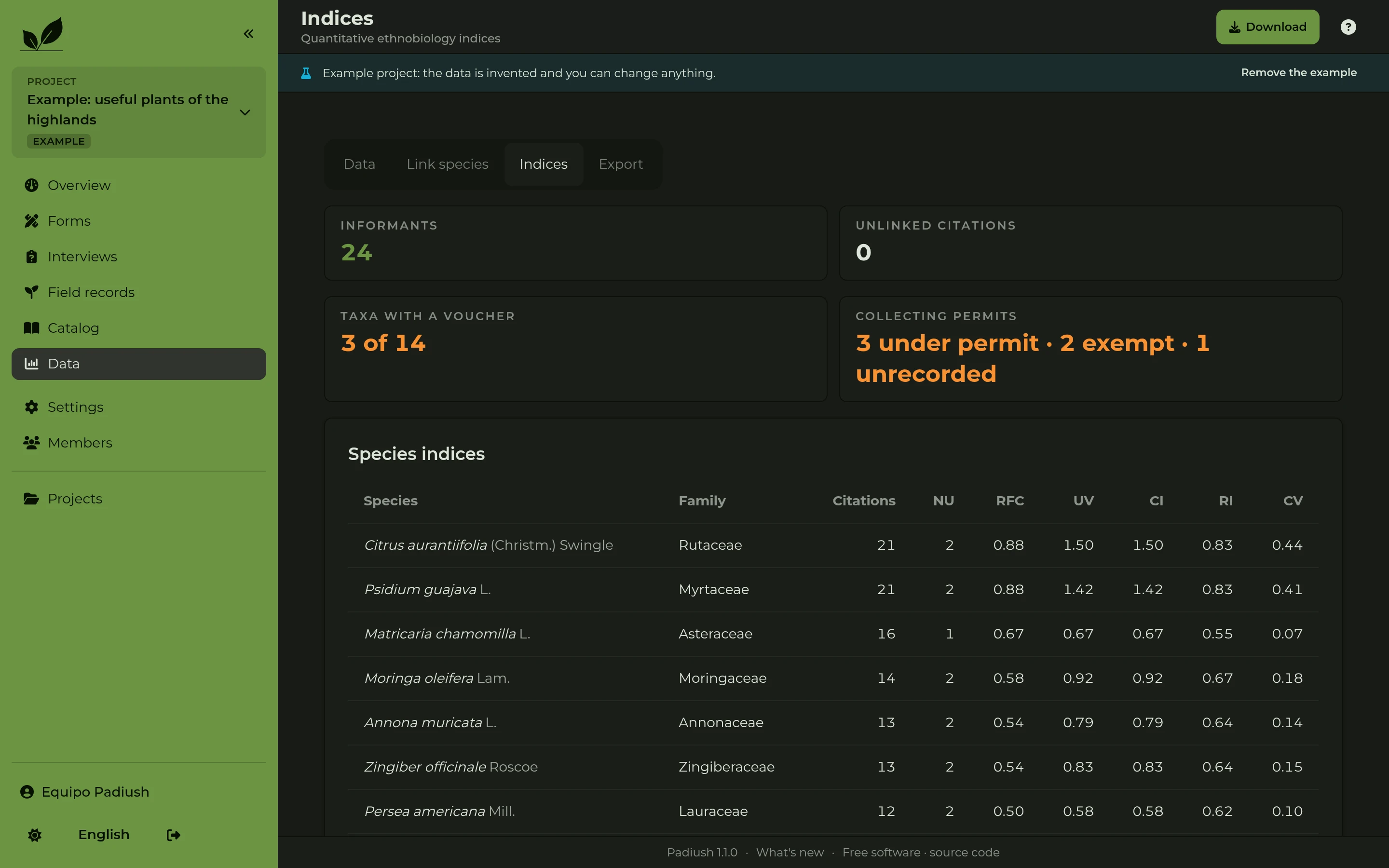
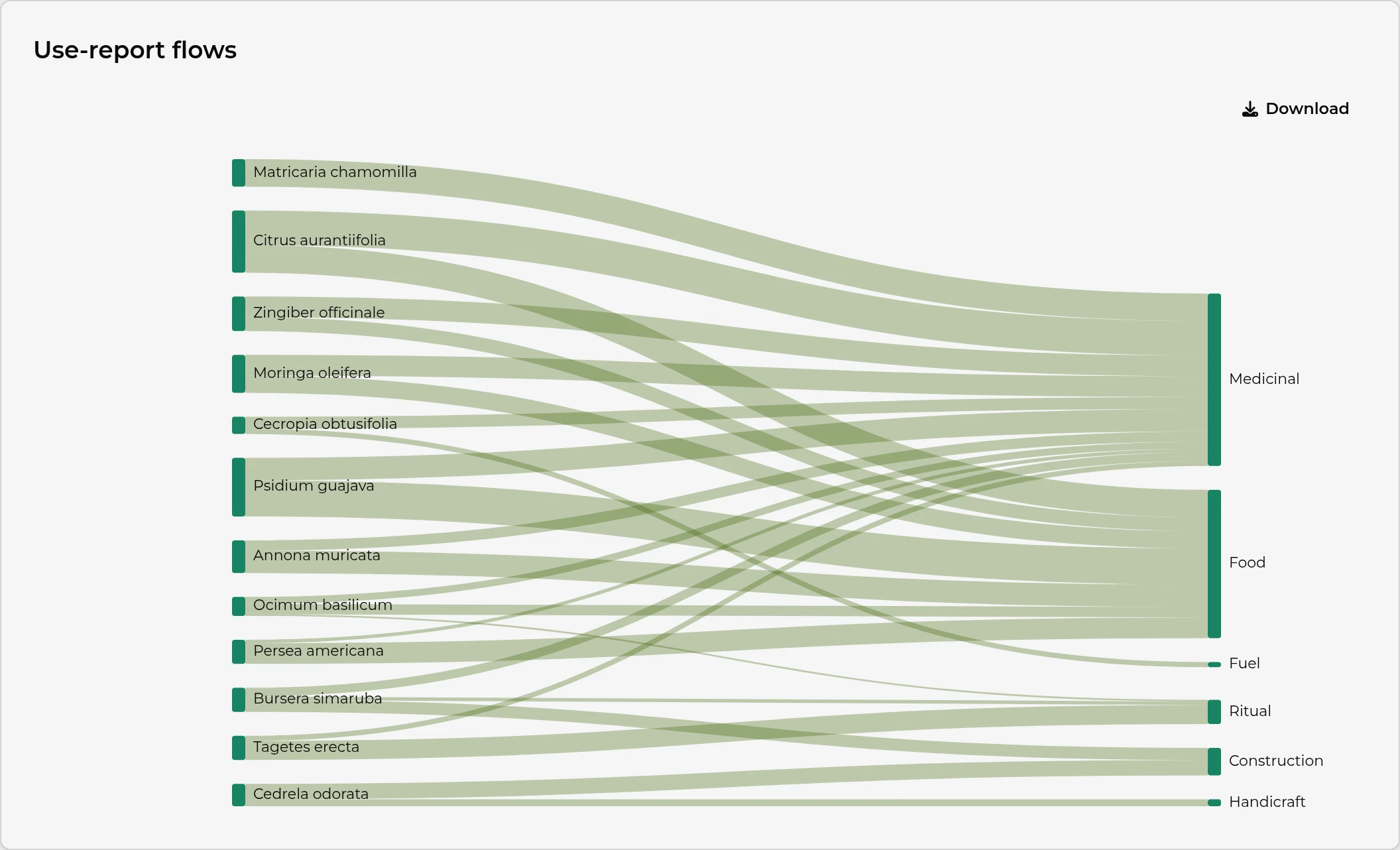
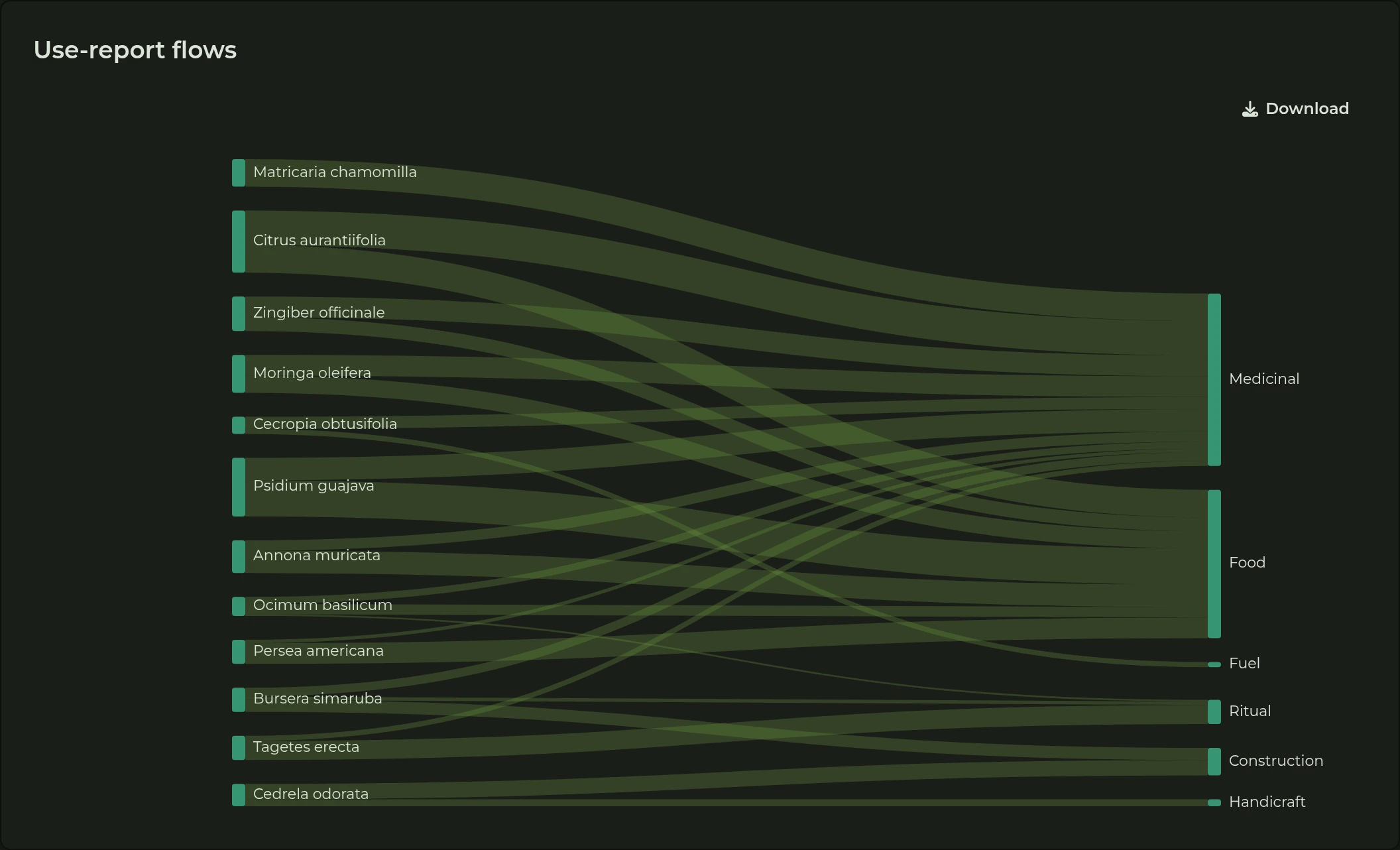
Real output from the platform, generated with the example study.
One chain of data
What you record in the field is what you analyse. Nothing gets transcribed twice.
- 1
Design the instrument
Build the interview form with repeatable sections, local-name fields and use categories.
- 2
Work in the field
The field app works with no signal. Interviews, records, location, audio and photographs stay encrypted on the phone until the network comes back.
- 3
Reconcile the taxonomy
Link each reported name to an accepted taxon. The original name the interviewee used is never lost.
- 4
Publish the results
Calculate the indices, review the charts and export to CSV, Excel or the ethnobotanyR package.
Field capture
It does not depend on having signal
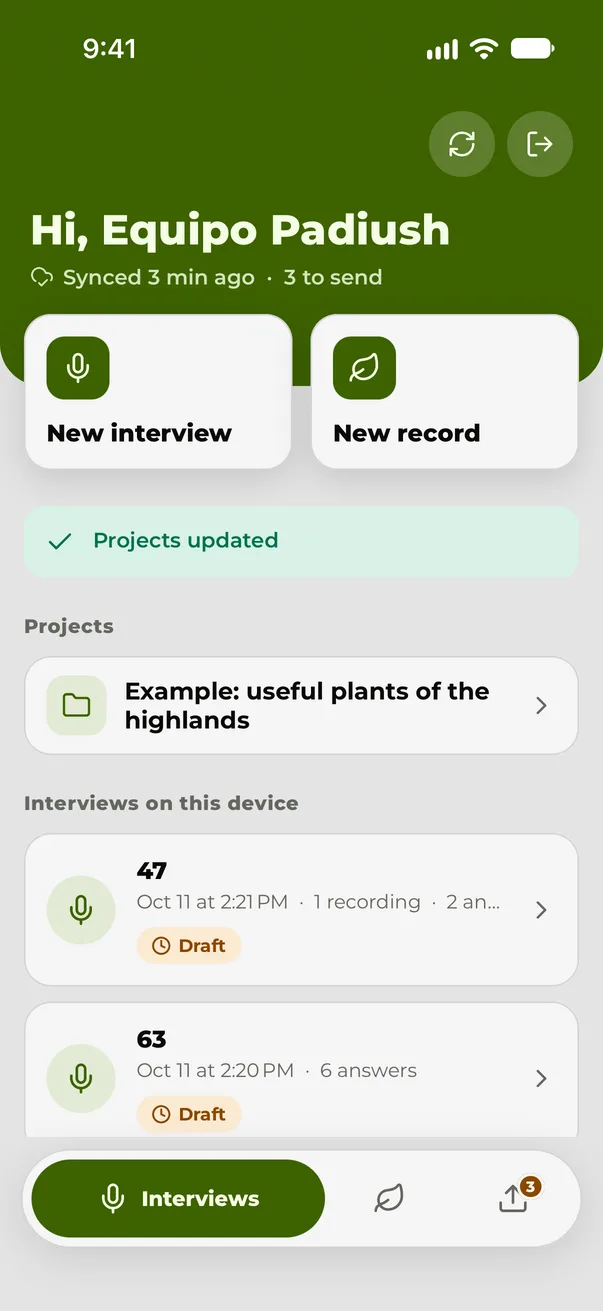
The field app, Padiush Companion, keeps every interview and every record on the phone and sends them when a connection returns. Each one carries its own identifier, so retrying a send never duplicates data.
- Answers, GPS location, audio and photographs
- Local store encrypted with SQLCipher; the app refuses to capture if encryption is unavailable
- If the connection drops, large files pick up where they left off
- You always know when you last synced and what is still to be sent
 Coming soon to Google Play

Field records
Every specimen, with its history
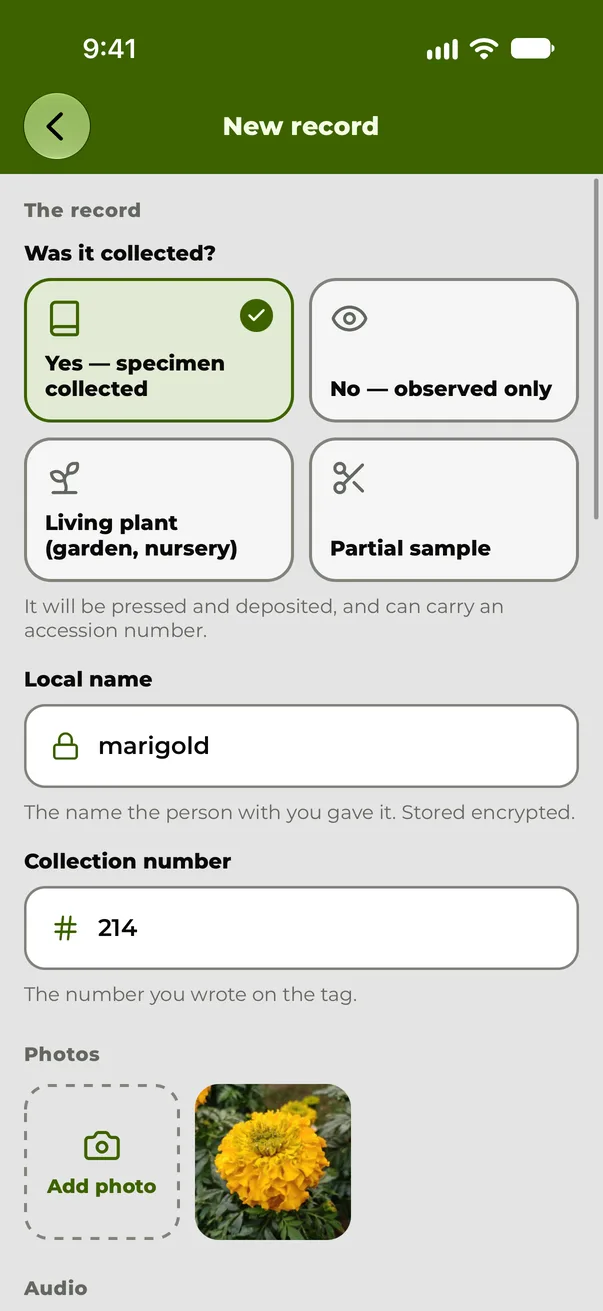
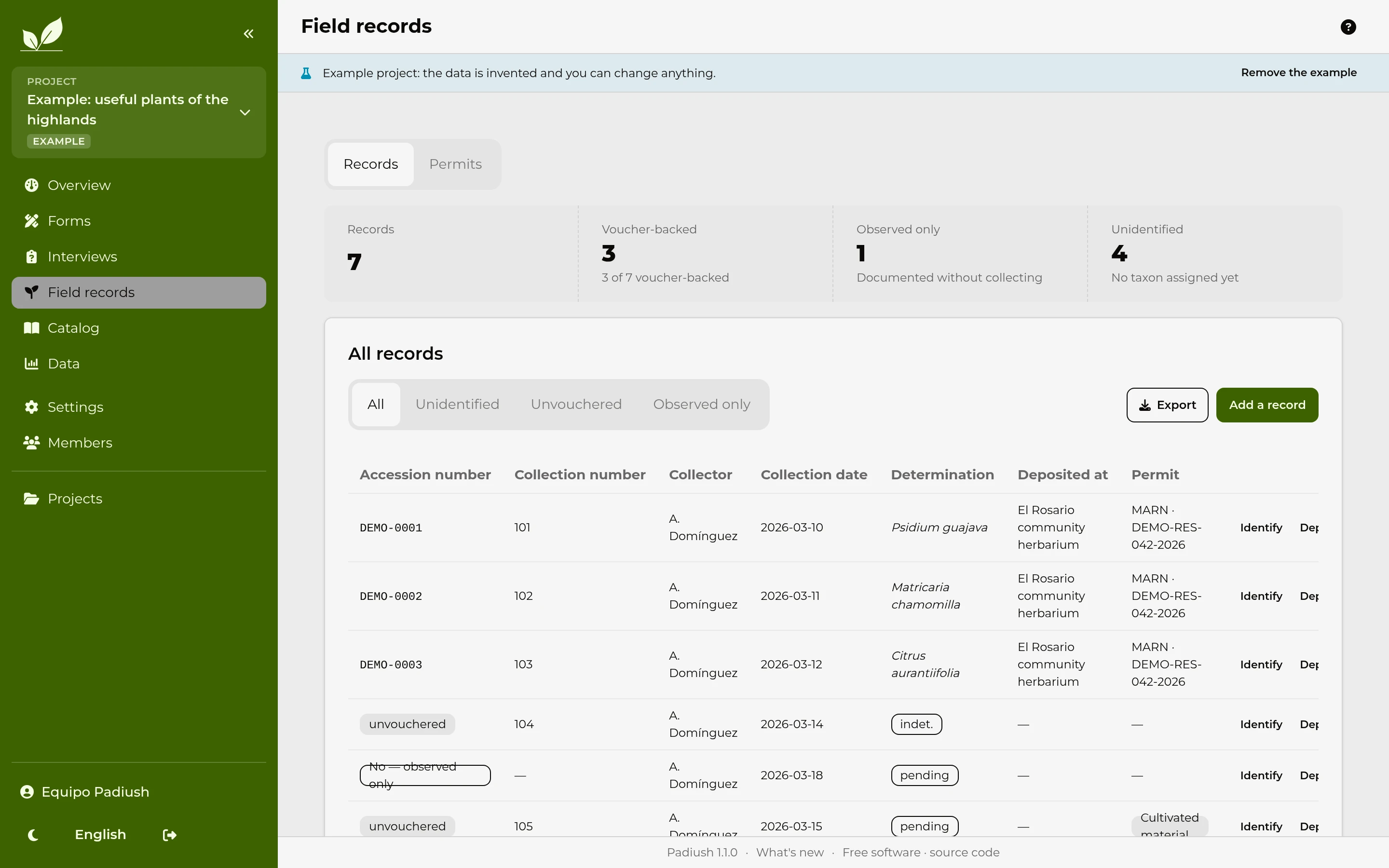
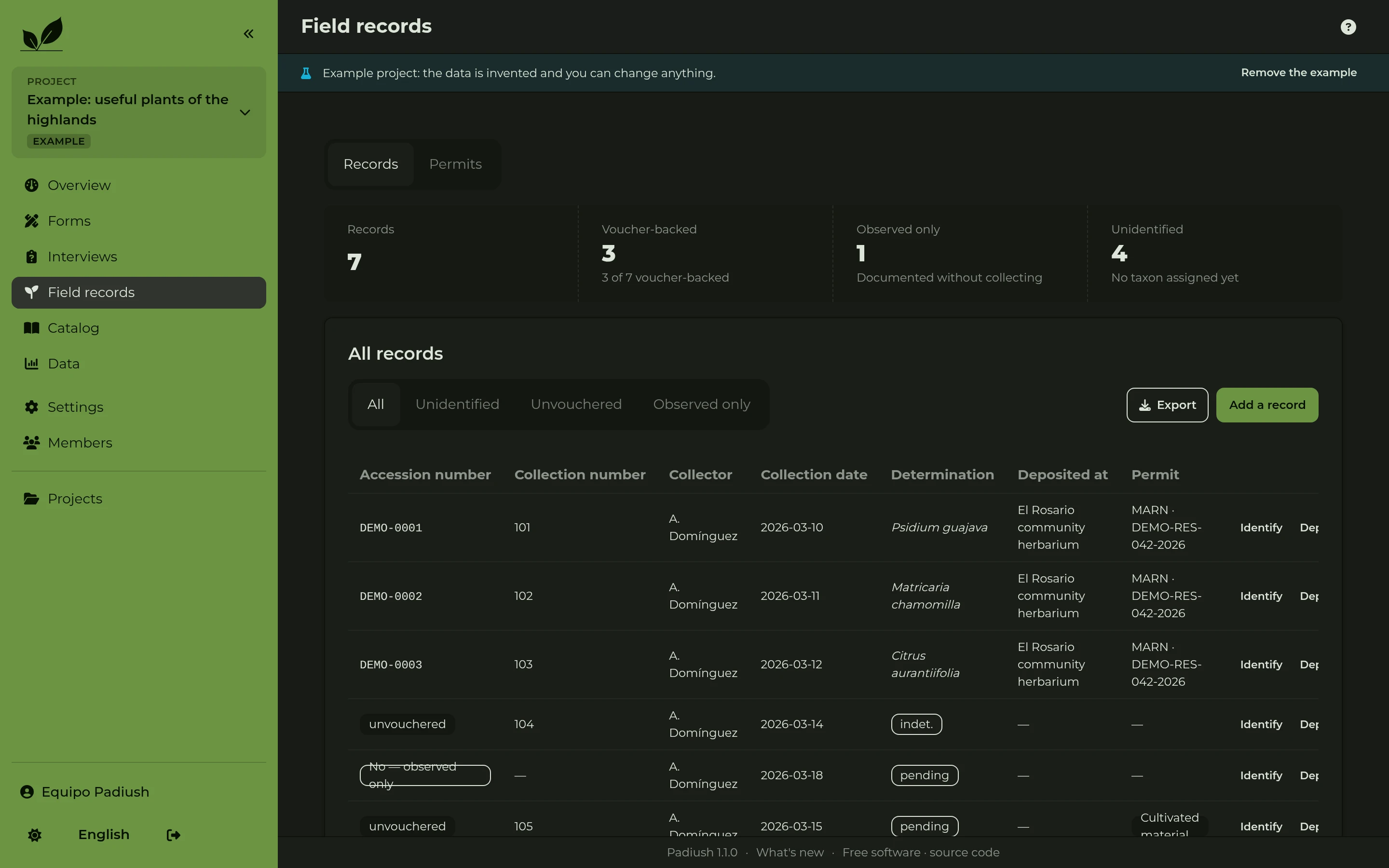
Document observations and collected specimens with coordinates, photographs and a voice note, from the phone or from the web. A record can start from an interview answer that names the plant, and stays linked to it.
- Observations and collected specimens, with project accession numbers
- A determination history: who identified each specimen, as what, and when
- Collecting permits recorded and attached to each specimen
- The answer each record came from, one click away
Taxonomy
Local names, accepted taxa
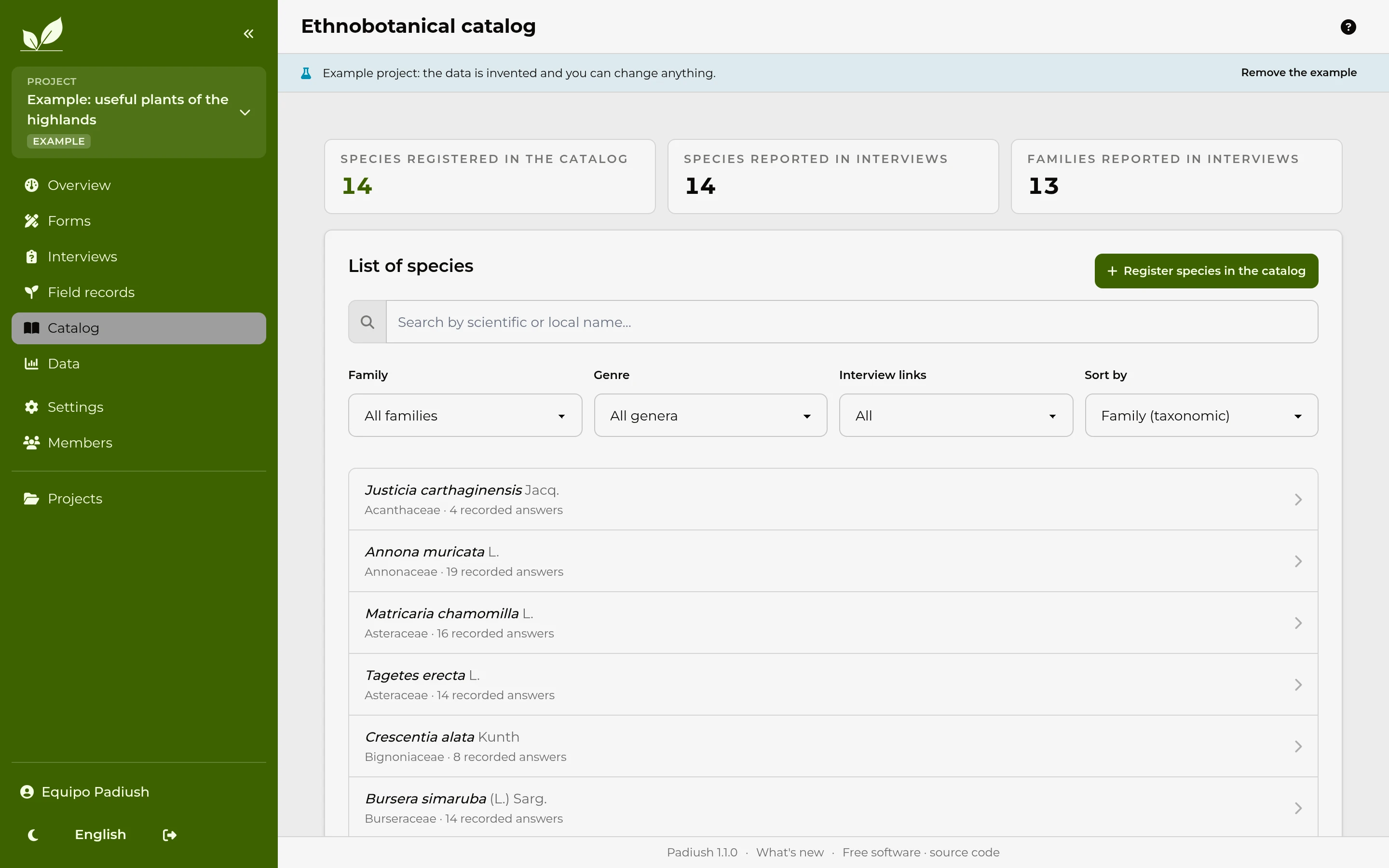
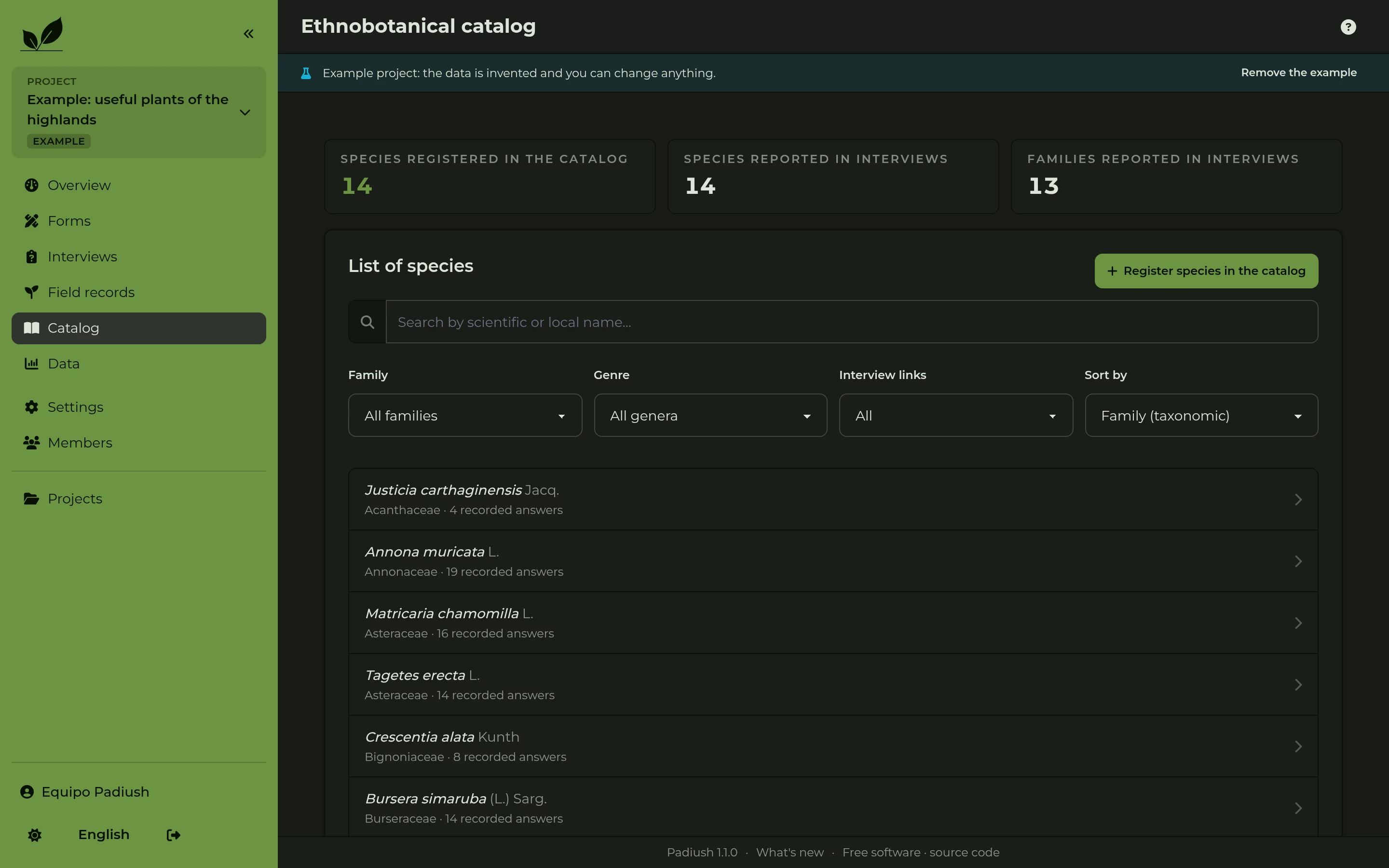
Search World Flora Online from the species page, adopt the accepted name and keep a record of where the change came from. Distribution comes from the World Checklist of Vascular Plants through GBIF, and an iNaturalist reference photograph helps confirm the identification.
- Authorship-aware matching and spelling-variant detection
- Synonyms and accepted names clearly distinguished
- Native and introduced distribution by botanical region
- The name reported in the field is always preserved
Analysis
Quantitative indices with their formulas cited
The classic measures of quantitative ethnobiology, calculated on your data, each with the reference that defines it and worked examples verified against the literature.
- Tables by species and by use category, plus fidelity level
- Bar charts, a heatmap and a use-report flow diagram
- Download as SVG or PNG, with your choice of background and resolution
- Export to CSV and Excel, and an informant × species matrix for ethnobotanyR
Indices included
What you can expect
Your data is yours
You keep ownership of your research. We do not sell data, we do not run advertising, and we do not train artificial intelligence models on it.
Encryption where it matters
Answers are encrypted in the database and the phone’s store is encrypted at rest. From your account you can see which browsers and phones you are signed in on, and sign any of them out.
Teams with real permissions
Invite collaborators with different roles: the person capturing, the person analysing and the person only consulting each see something different.
Provenance at every step
Who recorded what, which source a name came from, and what a value was before a correction: all of it is written down.
Start with an example study
With your account you can open a copy of the example study, with interviews, records, species and indices already calculated, and explore it before you design your own. The first time you open each section, a short tour shows you how it works.
Create your accountWould you rather talk first? Write to us and tell us what you are documenting.